日期:2024-10-09 分类:Product knowledge 浏览:1140 来源:Guangdong Youfeng Microelectronics Co., Ltd
TVS diodes are divided into bidirectional and unidirectional. So, what is the difference between these two types?
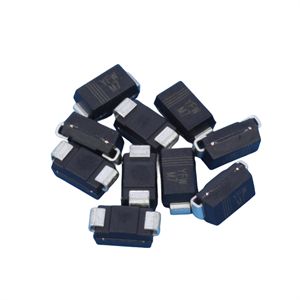
One end of the unidirectional TVS diode has a thin colored ring connected to the positive terminal; There are two rings marked in the middle of the bidirectional TVS diode, or no markings or polarity. The bidirectional TVS diode can absorb instantaneous high pulse power in both positive and negative directions, and convert the voltage
Clamp to the predetermined level. Bidirectional TVS diodes are suitable for AC circuits, while unidirectional TVS diodes are generally used for DC circuits.
In reverse operation, the maximum pulse peak current allowed for the device to pass through under specified pulse conditions. The product of iPP and the maximum clamping voltage VC (max) is the maximum value of transient pulse power. The Forward Characteristics and Universal of Unidirectional TVS Transistors
The same applies to Zener diodes.
The reverse breakdown inflection point is approximately a "right angle", which is a type of hard breakdown and a typical PN junction avalanche device. The curve from the breakdown point to the VC value shows that when there is an instantaneous overvoltage pulse, the device current suddenly increases, while the reverse voltage rises
Go to the clamp voltage value and maintain it at this level.
TVS should be selected correctly during use, so that the rated transient pulse power PPR is greater than the maximum transient surge power that may occur in the protected equipment or line. In the area where breakdown occurs, at the specified test current I (BR), at both ends of the device
The measured voltage is called breakdown voltage. In this region, the diode becomes a low impedance path.
上一篇: 暂无数据
下一篇: 暂无数据